The Non-Main-Semeai Solutions
Black O8 as Move #11 (1 Jigo)
|
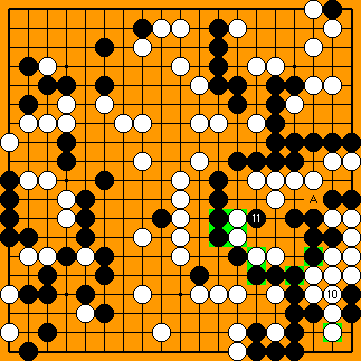
Black's encirclement is complete, so White is forced to connect her stones in Atari at the right edge with Instead of connecting with |
 2610
2610 .
.  , as usual, Black attaches at
  , separating White's forces in the Hanezeki.
|
|
The Jûrokubango has come to an end. |
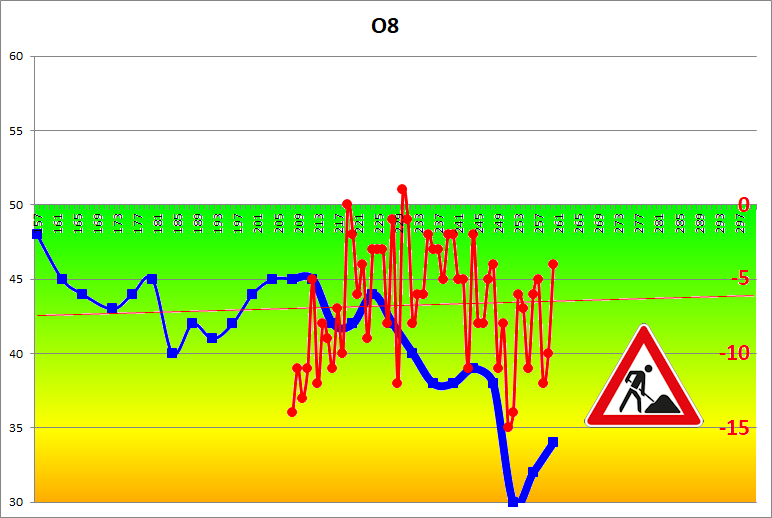
Over the course of 28b's training, Black's Initial Self-Play Success Ratio (the blue line in the diagram) showed a downward trend (with in some cases significant advantages for White) in the first two thirds and an upward trend in the final third. In the end, it stabilised in the "yellow" zone (so we will have to wait and see how things develop). |
28b's surplus of won games in the Jûrokubango (the red line in the diagram) was predominantly in the range of -5 to -10 (which means that 28b had by no means grasped this variation as well as 40b), with only slight improvements over time. In the final third, however, there is a sharp rise into the positive range. Consequently, 28b ultimately handles this variation better than 40b. |
|
It is therefore highly likely that we are looking at a viable solution here ! |
#280: |
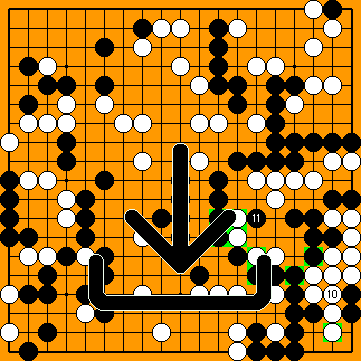
Please click the board for SGF-download ... |
Please click the board for SGF-download ... |
The comments indicate the number of games in which the respective variation was selected. | |
Black O8 as Move #13 (1 Jigo)
|
Black's encirclement is complete, so White is forced to connect her stones in Atari at the right edge with Instead of connecting with Black has already inserted the first exchange for reducing White's territory in the upper right corner. |
|
|
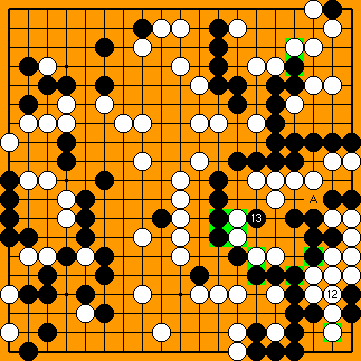
 .
.  , separating White's forces in the Hanezeki.