Motivation
In May 2024, I started training a KataGo 28-block network (= "28b") using the training data previously generated by the KataGo 60b network. In July 2024, the 28b network had caught up (after a good 140 generations), so the self-play with the 60b network was terminated and continued with the 28b network.
In October 2024, I then experienced massive hardware problems, which seriously slowed down further development.
So I now concentrated the self-play training on the non-Main-Semeai variations, with a few more of these variations emerging from time to time in the 16-game matches (= "Jûrokubango") between Karl's 40b network and my 28b network, which started from the problem's setup. Data for training the 28b network has now also been generated in additional Jûrokubango for several non-Main-Semeai variations in each case.
For some of these non-Main-Semeai variations, it seems to have been consolidated in the meantime that they represent valid solutions to the problem. You will find more details on this in subsequent pages.
For completed Jûrokubango tournaments, you can download SGF files containing a summary of the games from each tournament that ended in a draw / Jigo (Komi decreased by two points).
 2600
2600
Starting Points of the
Non-Main-Semeai Solutions
During the Formation of the Hanezeki
|
The first opportunities to deviate towards a non-Main-Semeai solution arise in the initial phase of the formation of the Hanezeki, i.e. as long as the outer blockade is not yet complete ( Black may already have inserted the first exchange for reducing White's territory in the upper right corner ( |
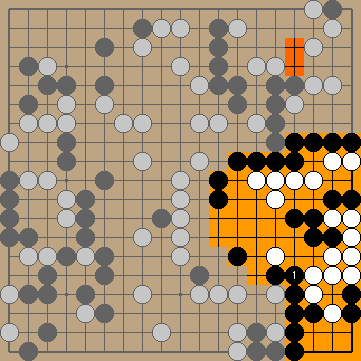
 ).
). ).
).After the Completion of the Hanezeki
|
The second phase of generating non-Main-Semeai solutions begins immediately after the completion of the Hanezeki, i.e. when the Tail's length is two stones. It ends when the Tail begins to move upwards ( Black may already have reduced White's territory in the upper right corner to varying degrees ( Black may have dispensed with an Atari in the Hanezeki ( |
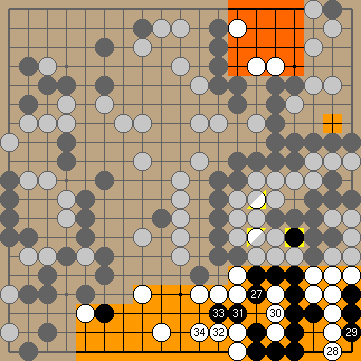
 ).
).Just Before the End of the Crosscut-Sequence
|
The next opportunity for non-Main-Semeai solutions comes immediately before the final exchange to complete the Crosscut-Sequence in the upper left centre ( Black may already have reduced White's territory in the upper right corner to varying degrees ( Black may have dispensed with the marked forcing exchanges at the bottom and in the left centre ( |
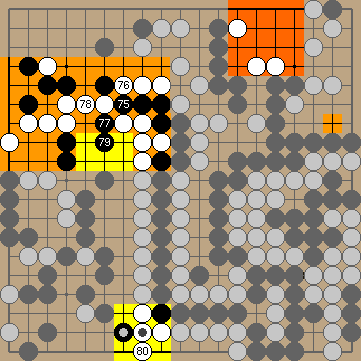
During the Formation of the Nakade
|
Even after completing the Crosscut-Sequence, non-Main-Semeai solutions are still possible ( Black may already have reduced White's territory in the upper right corner to varying degrees ( The Guzumi Exchange in the top right may already have been played ( | |
|
|
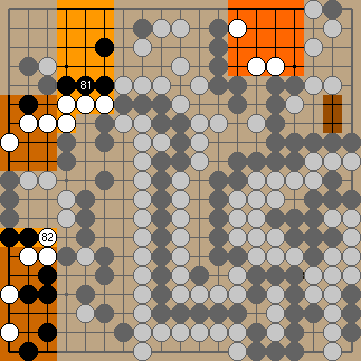
 ).
). ).
).
十六番碁 – Jûrokubango
16-Game Matches Between 28b and 40b
Karl Defontaines' self-play training of his 40b network and my training of the (initially) 60b network (later 28b) followed completely different philosophies. |
In contrast to Karl, I was unable to find access to the "hintpos" support of the self-play training, with which KataGo were able to detect its own incorrect evaluations. |
For the 16 games per version of my net between 60b (28b) and 40b are combined:
"Root visits per move" depends on the net, the position, and the familiarity of the net with the position, so "visits per second" might not be really suitable for an overall comparison within the Jûrokubango. |
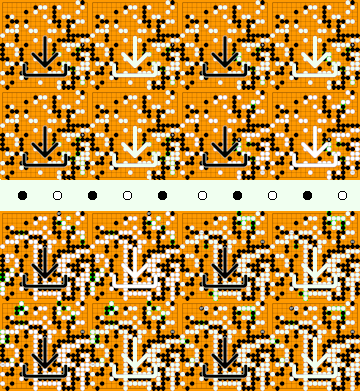
Please click the boards for ZIP-download of all Jigo-Games of all finished Jûrokubango ... |
The comments indicate the number of games in which the respective variation was selected. |
|
|
Change Log
| Mai 15, 2026 |
|
| Mai 15, 2026 |
|
| Mar 30, 2026 |
|
|
| ||

